

The Menden-based company presented innovative exhaust aftertreatment systems and components at the leading international technology trade fair for off-highway applications.
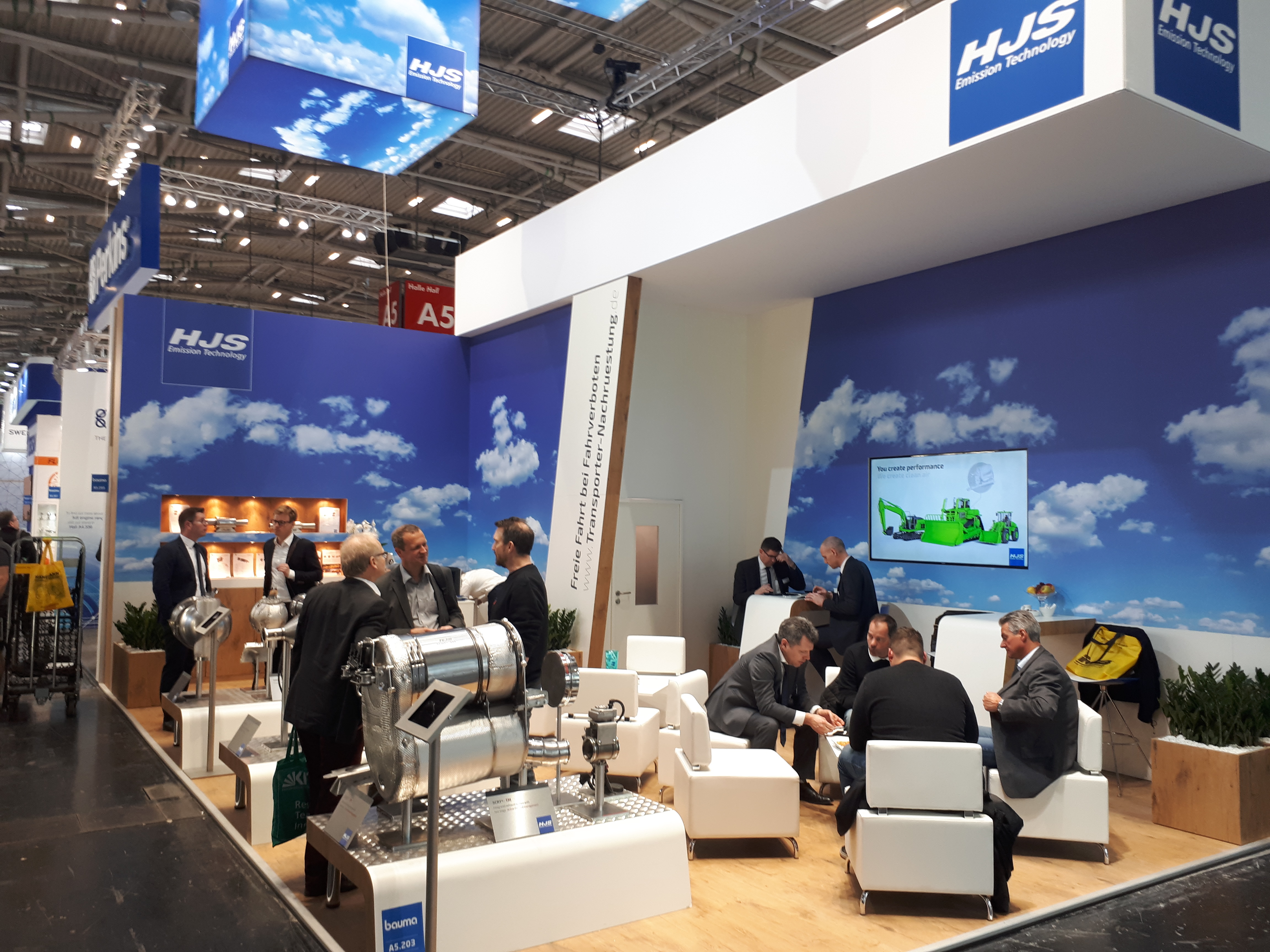
Holistic system solutions
The holistic HJS system solutions and innovative components for the exhaust tract have met with widespread interest from engine and machine manufacturers.

The focus of interest was on the EURO VI or Stage V-capable SCRT®-TMcompact system – integrated two-stage thermal management with an electric heating catalytic converter and an exhaust backpressure flap are just two of the technological highlights of the system solution for diesel engines with up to 300kW output: The integration of an SCR catalytic converter with a volume of more than 30 liters, a very compact package, the intelligent HJS Aftertreatment Control Unit (ACU – system control for all components) and the highly efficient thermal insulation demonstrate the comprehensive system competence of HJS development and production.
Innovative system modules
“We are constantly supplementing this broad portfolio of system solutions for engines and machine manufacturers with innovative functional modules that meet even the strictest emission requirements in a robust and cost-effective manner,” explains HJS Managing Director of Technology Dr.-Ing Christoph Menne. For example, the HJS innovative HJS Swirl Cap Mixer has been developed in three different sizes for an engine range of engines from < 100kW with up to 500kW: “We integrate the complete mixture preparation for the AdBlue® into the outlet hood of a DOC or DPF – a clear installation space advantage compared to classic system arrangements,” Menne continues. The dosing of the urea water solution (AdBlue®), which is mixed with the exhaust gas and vaporized, takes place in the mixing section.
The diameter and length of the hood mixer can be scaled as part of the HJS modular system. This means that integration into a wide variety of installation spaces is possible without any problems. The function does not suffer in any way due to the compactness. Almost complete evaporation can be achieved and the uniform distribution upstream of the SCR catalytic converter is very high. Highest NOx conversions of 97% and more, as well as the minimization of critical deposits are the result. High robustness, low CO2 emissions and pollutant emissions below the Stage V limit values – the new product family from HJS resolves this seemingly contradictory conflict of objectives. Whether horizontal or vertical, a flexible installation position close to the engine is possible even in the smallest installation spaces.
HJS Manager Menne is satisfied with the outcome of the trade fair: “The development managers of various well-known international engine manufacturers were impressed by the innovative mixture preparation concept at the HJS stand. After intensive development work, we are very happy that with our new product we not only meet the requirements of Stage V legislation and beyond, but can also offer our customers and partners a compact and robust solution for different engine outputs and displacement classes”.
Retrofit solutions for diesel vehicles in the trade
In addition to systems and components for original equipment, HJS also presented retrofit emission solutions at BAUMA. Sintered metal filters for construction machinery, which can be actively regenerated independently of the engine, were presented. The SCR systems for tradesmen’s and delivery vehicles also met with great interest. The German government supports the retrofitting of tradesmen’s and delivery vehicles with a financial subsidy of up to 80%.
In its products for commercial vehicle retrofitting, HJS relies consistently on the SCRT® system architecture, which has been tried and tested millions of times, supplemented by active thermal management. This system design achieves significantly higher efficiency levels, particularly in the urban low-load range. The system works independently of the engine system and without secondary lines in the exhaust tract.
As a certified series supplier to the automotive industry, HJS ensures functional and manufacturing quality in accordance with the current quality standards ISO 9001:2015 and VDA 6.1/6.2. In future, the systems can be purchased and installed by qualified vehicle workshops.
Depending on the system variant and vehicle size, the price for typical vans and tradesmen’s vehicles will be in the region of €4,000 for vehicles in the N1 category (2.8t-3.5t) and from around €5,000 for the N2 category (3.5t-7.5t) – plus the installation costs for a one-day workshop visit. Depending on the vehicle type, around 3%-5% Adblue® of the diesel consumption can be expected, the additional fuel consumption is less than 6%.