

The Sauerland-based company HJS is the market leader in the field of exhaust gas
aftertreatment: Thanks to the technologies developed in-house, hundreds of thousands of diesel vehicles are driving cleanly on Europe’s roads. The filter technology matured on combustion engines has such promising properties that HJS is now extending the field of application to industrial filtration.
Since the 1990s, HJS Emission Technology in Menden has been developing and producing filter solutions that are primarily used in the automotive industry. The company meets the strictly controlled environmental regulations for diesel engines with the help of self-developed particulate filters, which filter soot and fine dust from the exhaust gas. The hot exhaust gas flows into the filter housing and through a coated, porous sintered metal mesh, which traps almost all soot and dust particles in microscopically fine pores. Almost 100 percent of the impurities are trapped, and only clean exhaust gases come out of the exhaust.
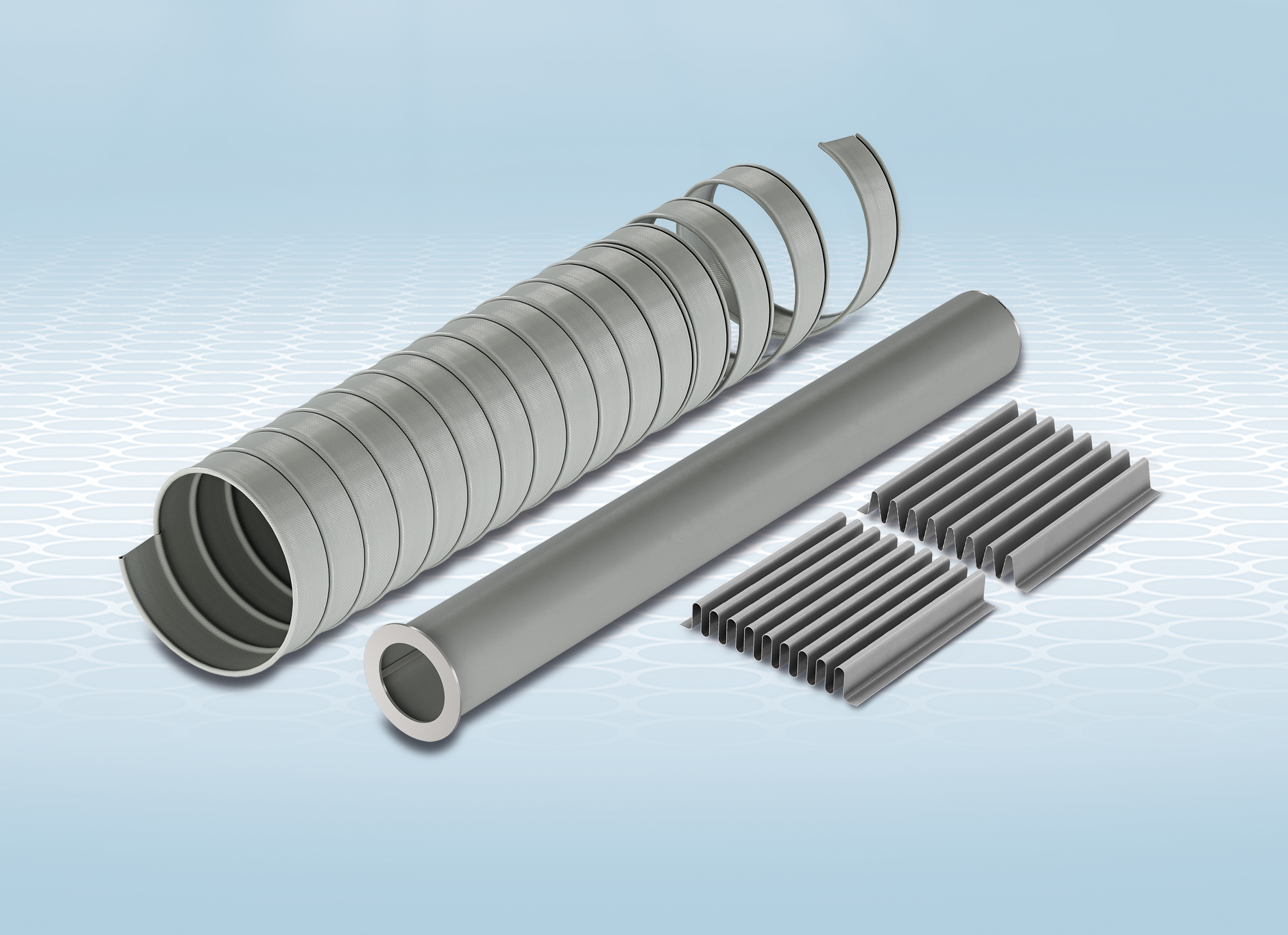
A simple operating principle, for the development of which HJS received the German Environmental Award in 2003. The filters do not require ceramics and are made of sintered metal: a metal powder mixture is applied to an expanded metal grid under pressure and heat. The result is a thin strip material less than half a millimeter thick with a porous metal surface that has a number of practical properties for use as a filter. They can be individually machined and formed into a wide variety of designs for any application, filter reliably at high operating temperatures and have a high inherent stability, so that no additional support bodies are required. Cleaning the filters is simple, can be automated and also works during operation. Once the service life of a filter has been exceeded, it is completely recyclable.
The technology has been tried and tested for years in the automotive sector, but its versatility also makes the material interesting for industrial applications. This is why HJS now wants to demonstrate its growing expertise in new fields of application: There is an enormous demand for filtration solutions in industry. It is used in the fields of biotechnology, food production, drug and vaccine production and the entire range of the chemical industry, from industrial gases to petrochemicals. The Sauerland-based company has identified hot gas filtration in factories, workshops and heavy industry as suitable areas of application. Liquids can also be filtered efficiently and with low maintenance using sintered metals: “Sintered metal filters are extremely stable and easy to clean. Our tests have shown that they are particularly suitable for hydraulic and fuel filtration tasks,” explains Klaus Schrewe, Head of Innovation and Strategic Product Management at HJS. “However, the product also offers a wide range of applications for all gases and liquids – because it can be used so flexibly.”
Independent tests certify that the HJS sintered metal filters have an ePM1 value of 85 percent and thus fulfill the requirements for industrial gas filtration. In the multi-pass test with hydraulic oil, an efficiency of 9.6 µm is achieved at Beta 100. One plasma technology company is already using HJS filters. Sintered metal is also predestined for hot gas cleaning in lime and cement works thanks to its thermal properties. In contrast to conventional bag filters, the complex and energy-intensive cooling of the hot gases is no longer necessary with the help of metal spiral-wound cartridges made of sintered metal.
At its site in Menden, the company can produce up to 300,000 square meters of sintered metal per year on endless belts in an automated and OE-compliant manner. Behind the simple-sounding filter principle lies years of research and the continuous search for clever filter designs and suitable base materials. HJS can now also use its decades of experience in closely controlled exhaust gas aftertreatment in the industrial sector. The company will be present at FILTECH, the trade fair for filter and separation technology in Cologne, from March 8 to 10 to promote the extended application of the technology.