

SCRT®retrofitting: small intervention, big effect
HJS has been making diesel vehicles sustainably clean for over 10 years”
The air we breathe consists of 99 percent nitrogen (N2) and oxygen (O2). None of them are, the latter is even a basic prerequisite for our lives. In chemical reactions such as combustion, these two harmless substances react to form nitrogen oxides (NOx), which are harmful to the environment and human health: gaseous compounds that cause premature ageing and stunted growth in plants and lead to acidification in soil and water. In the human organism they have a severely toxic effect by irritating the respiratory tract and the cardiovascular system. What is particularly critical here is that, unlike soot or other pollutants, you cannot see or smell the pollutants.
Against this background, limit values also apply in the European Union to reduce the impact of these pollutants on people and the environment. In addition to industry based on fossil fuels, road traffic and diesel engines in particular are considered to be a major polluter. Pollutants are released from the exhaust particularly quickly into our living environment and thus directly into the air we breathe. Every gram of nitrogen oxide saved in traffic is therefore a short-term contribution to clean city air and saves lives in the long term.
As a result of progressive legislation in recent years, vehicle and engine manufacturers, together with their innovative suppliers, have developed technologies that correctly remove these pollutants from the exhaust gas.
HJS is proud to have been part of this innovation since the late 1990s. The basic patent for the technology for the combined reduction of soot particles and nitrogen oxides (SCRT®) goes back to a consortium of the companies Daimler, Johnson-Matthey and HJS and has been used in commercial vehicles since the Euro IV generation.
HJS has made this technology independent of the vehicle and engine, thus creating the possibility of retrofitting corresponding systems in existing vehicles or machines. HJS has been retrofitting diesel engines throughout Europe with this concept for around ten years. The Sauerland-based company played a decisive role in developing the technology behind it in the 1990s and has retrofitted several thousand vehicles with it to date. The retrofitting of HJS alone has prevented the production of thousands of tons of nitrogen oxide within a decade. While the value to health cannot be quantified, the costs saved to the healthcare system by reducing air pollution are in the millions. Particularly attractive is the fact that high-priced capital goods such as buses, special municipal vehicles or construction machinery can be easily and very economically upgraded to the current state of the art.
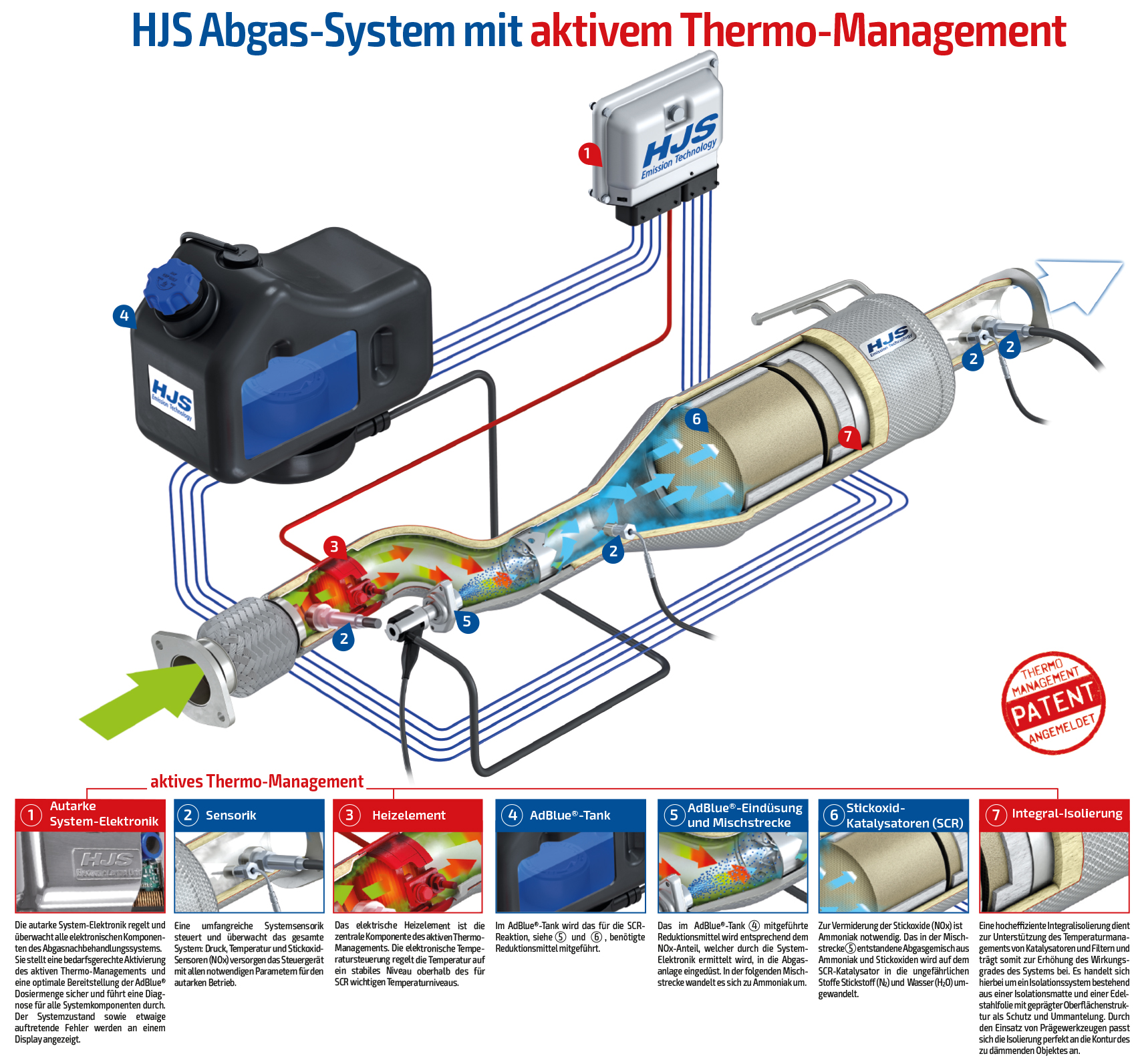
The German government’s “Clean Air Immediate Action Program” was an important milestone following the discussion about clean diesel in real operation (so-called Real Drive Emissions) and Dieselgate, especially for passenger cars. The technical objectives of the retrofitting campaign go beyond mere technological retrofitting and require an almost complete reduction in nitrogen oxide emissions, especially in urban areas. This is where first-generation systems often reach their limits. Stop & go operation means that they literally “do not come up to temperature”. Modern exhaust gas aftertreatment in commercial vehicles works with active engine management to avoid this. HJS has realized this with active temperature management in various expansion stages independent of the engine. SCRT(T) has become SCR(T)-TM Diesel buses retrofitted by HJS, for example, emit up to 90% less pollutants than with first-generation SCR systems. The Federal Ministry of Transport therefore classifies them as new purchases in connection with clean air measures. This allows owners to determine the running time of their fleet independently, regardless of environmental zones.
Newly registered vehicles (Euro 6d/temp generation passenger cars and Euro VI commercial vehicles) are generally as clean as possible in real-world operation. But the story is not over yet
Last year, the World Health Organization (WHO) called for new, even stricter limit values for air quality, and the EU also intends to implement these in the future following a request from the EU Parliament. In the run-up to the Bundestag elections, the B90/The Greens were not alone in expressing the specific aim of meeting these limits, possibly even before they are introduced throughout the EU.
Despite all efforts, these new targets will not be fully achievable with the electrification of passenger cars. The introduction of new emission limits for cars and commercial vehicles will also have to play a part in this. HJS is already preparing for this further development of our products. In addition to the necessary components for new drives, there will also be solutions in the future to further improve even the new Euro 6/VI generation vehicles, which are already very clean.