

Menden, July 11, 2018 –HJS receives ABE for state-of-the-art exhaust technology for retrofitting public transport buses.
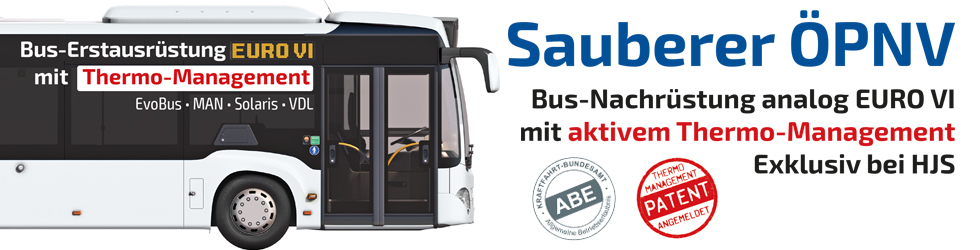
The latest buses in local public transport must now comply with the Euro VI emissions standard. Even from the point of view of critical environmentalists, these vehicles are clean in terms of their pollutants. There are currently more than 28,000 city buses in Germany that have not yet been registered with these modern engine and exhaust concepts in recent years and therefore also contribute to inner-city pollution.
HJS has now introduced an exhaust technology for these diesel buses that can be retrofitted to existing vehicles on the market. The installation achieves a drastic reduction in pollutants of over 90 % in some cases. Vehicles equipped with this HJS technology are classified and financially subsidized by the Federal Ministry of Transport in the same way as the latest buses.
HJS has been developing this sophisticated technology for more than 2 years:
- Real emission level of Euro VI buses for existing vehicles
- Functional stability under all boundary conditions down to -7°C
- HJS retrofit solutions fulfill BMVI funding guideline
- The system has a general operating license (ABE)
The many years of experience gained from working with the engine and vehicle industry was helpful here.
Promotion by the federal government
On average, public transport buses travel more kilometers per year in cities than all other road users, whether cars or trucks. For good reasons, whether schoolchildren, pensioners or working people, the bus is an indispensable way for everyone in the city and the surrounding region to reach their destination reliably.
The high mileage and the daily need for public transport for many citizens has prompted the German government to provide funding of more than €100 million for buses already on the market in order to use this financial incentive to reduce the high levels of nitrogen oxide pollution in cities as soon as possible with clean buses. The aim is to avoid driving bans.
General operating license secures federal funding
At the beginning of July, the German Federal Motor Transport Authority (KBA) granted HJS the first general operating permit (ABE) for retrofitting the entire Euro V / EEV MAN bus family. Retrofitting with the proven HJS SCRT® technology supplemented by active thermal management ensures the best possible reduction in nitrogen oxide emissions for buses in urban operation – on any route and at any time of year. Retrofitting buses with this HJS technology is therefore one of the most effective and efficient measures to reduce nitrogen oxides in cities and thus actively contribute to avoiding driving bans: local public transport can thus be brought up to Euro VI level quickly and cost-effectively. The retrofitting is largely financed by the federal government in accordance with the funding guidelines published in March.
How SCRT®TMwith active thermal management works
Modern Euro VI city buses offer the highest level of exhaust gas purification through the combined use of particulate filters and SCR technology. However, buses in inner-city traffic often do not reach the temperature required for the SCR catalytic converter to function optimally. This effect is exacerbated in winter by the low ambient temperature. Vehicle manufacturers only meet the high requirements of the Euro VI emissions standard through the use of engine thermal management.
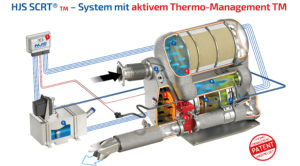
HJS transfers this concept as a self-sufficient system architecture to the retrofitting of existing vehicles. As co-owner of the SCRT® patent, HJS presents a retrofit solution with active thermal management based on this AdBlue® technology. The patent-pending solution from the established system supplier HJS was developed at original equipment level and enables the operation of existing EUROV/EEV vehicles with the emission quality of modern Euro VI buses. Thanks to active thermal management, the system is functionally reliable, even in wintry ambient temperatures and very slow
stop & go driving.
Active thermal management uses two networked actuators to ensure that the best possible NOx reduction is always achieved in the SCR catalytic converter – without influencing the engine. “The BMVI’s demanding funding guidelines make active thermal management indispensable. Otherwise, the necessary reduction performance of the systems cannot be guaranteed sustainably and permanently in real operation,” says Dr. Christoph Menne, Managing Director at HJS.
The system presented by HJS for the MAN bus family of the Euro V / EEV generation meets the funding guidelines published by the Federal Ministry of Transport as part of the “Clean Air Immediate Action Program” and is available immediately, with further variants for other bus manufacturers to follow in the second half of the year, and Daimler/EvoBus in the near future.
Press contact:
| HJS Emission Technology GmbH & Co. KGAnnette Ritz, Marketing ServiceDieselweg 12, D-58706 Menden/Sauerland | Phone: +49 2373 987-218E-mail: annette.ritz@hjs.comInternet: www.hjs.com |
About HJS:
As a medium-sized company based in Menden/Sauerland, HJS Emission Technology GmbH & Co. KG, founded in 1976, stands for many years of experience and expertise in the field of exhaust gas aftertreatment. More than 450 employees develop, manufacture and market modular systems for reducing pollutant emissions. The innovative environmental protection technologies are used both as original equipment and for retrofitting in passenger cars, light to heavy commercial vehicles and in mobile and stationary applications in the non-road sector. In addition to systems for petrol engines, HJS also offers solutions for diesel engines in particular – especially for the reduction of soot particles and nitrogen oxides. With extensive patent rights for DPF®(Diesel Particulate Filter) and SCRT®(Selective Catalytic Reduction Technology), HJS sets national and global standards.