

HJS Emission Technology has been awarded a contract by the SMS Group to supply filter elements for a hydrogen-based direct reduction plant for steel production. As a global group and plant manufacturer for the metals industry, the SMS Group is responsible for the overall engineering, supply and construction of this plant.
The project forms part of one of the world’s largest industrial decarbonisation initiatives. At its Duisburg site, Thyssenkrupp Steel is constructing an innovative plant for the production of direct reduced iron (DRI), which is set to be powered by green hydrogen in the future.
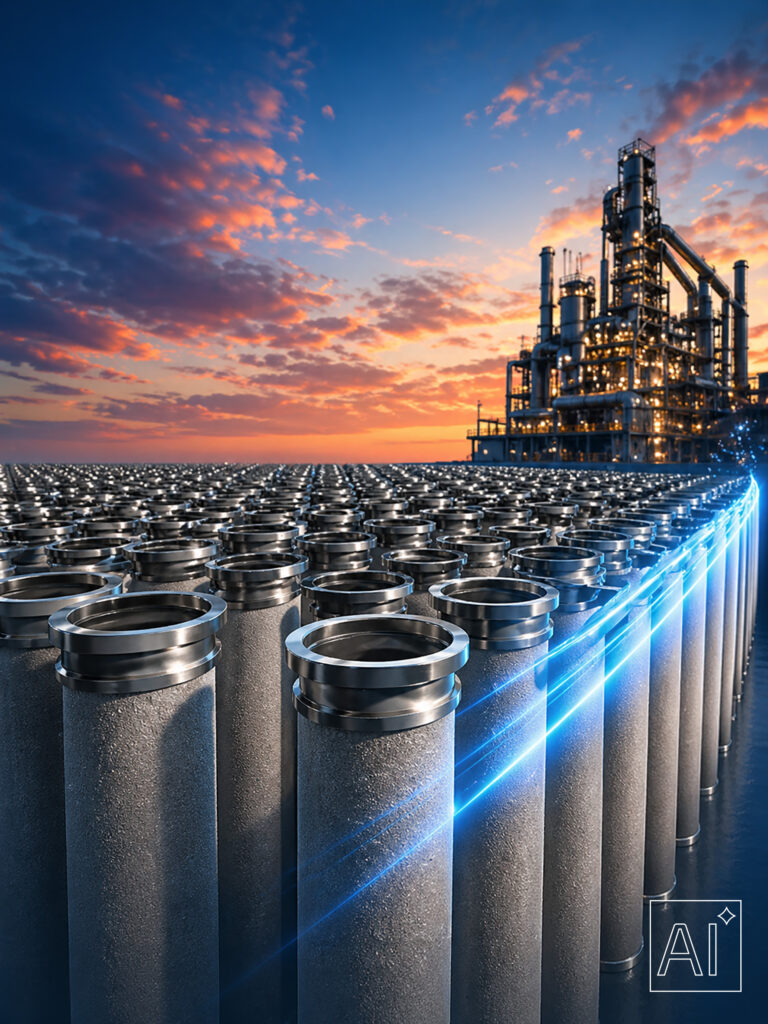
As part of this major project, HJS is supplying over 1,500 high-performance 5-metre-long filter cartridges made of sintered metal for the filtration of coke dust; these are specifically designed for use under extreme process conditions. The system filters abrasive dusts as well as chemically aggressive gas components. Unlike conventional textile filter bags, SMF® enables reliable separation of even the finest particles in high-temperature ranges above 400°C. In this way, SMF® technology makes a significant contribution to the efficiency and operational reliability of the entire plant.
Once completed, the new plant at Thyssenkrupp Steel will achieve an annual capacity of around 2.5 million tonnes of direct-reduced iron and has the potential to save more than 3.5 million tonnes of CO₂ per year.
The SMS group plans to use SMF® technology in other projects and plants within the group in future, given its high potential for efficiency gains.
Hubertus Borgmeier, Sales Manager at HJS Emission Technology: “This contract is a real milestone for HJS. Guided by our motto, ‘Innovation through Experience’, HJS is consistently developing its tried-and-tested sintered metal filter technology (SMF®) for applications in large-scale industry. In doing so, we are making an important contribution to the transformation of energy-intensive processes towards greater efficiency and sustainability.”
HJS is also already involved in several projects within the lime and cement industry, where the significant potential for CO₂ savings, as well as the high efficiency and performance of the filter technology used, have been successfully demonstrated under real operating conditions.
This opens up a field of technological innovation for HJS with significant market and growth potential.